

Acupuncture Therapy: Benefits, Practices & Wellness Tips
Acupuncture is one of the best-known therapies of Traditional Chinese Medicine (TCM). For thousands of years, it has been used as part of a broader approach to health that considers the body as an interconnected system rather than focusing only on individual symptoms.
Today, acupuncture is practiced in many countries and is increasingly included within complementary and integrative healthcare. Modern research has particularly examined its role in managing certain types of pain, including back pain, neck pain, osteoarthritis-related knee pain and headaches.
What is Acupuncture Therapy?
Acupuncture is a traditional therapeutic technique in which very thin needles are inserted into specific points on the body.
From the traditional Chinese medicine perspective, these points are located along pathways known as meridians. Traditional practitioners understand health in terms of the balanced movement of Qi, often translated as vital energy, through these pathways.
The traditional objective of acupuncture is to stimulate selected acupuncture points and support balance within the body’s functional systems.
Modern scientific research approaches acupuncture differently. Studies suggest that acupuncture can influence the nervous system, local tissues and the body’s pain-processing mechanisms. However, researchers are still studying exactly how its effects occur, and not all proposed traditional mechanisms have been established using modern scientific methods.
Traditional Chinese Medicine provides the traditional framework for acupuncture, while modern research continues to investigate its physiological effects.
A brief history of Acupuncture
Acupuncture originated in China and has been practiced in some form for at least 2,500 years. Over time, acupuncture developed alongside other components of Traditional Chinese Medicine, including herbal medicine, moxibustion, dietary practices, movement practices and other therapeutic approaches.
Its use is no longer limited to East Asia. The World Health Organization has developed benchmarks for acupuncture practice and training, reflecting the widespread use of acupuncture and the need for appropriate standards of practice, facilities, training and safety.
How does Acupuncture work?
There are two useful ways to understand acupuncture.
The Traditional Chinese Medicine Perspective
In TCM, the body is viewed as a connected system. Practitioners assess a person’s symptoms, constitution and overall pattern before selecting acupuncture points.
The traditional approach aims to restore or maintain balance and improve the flow of Qi through the body’s meridian system.
This is why two people experiencing similar symptoms may receive different acupuncture point combinations.

The Modern Scientific Perspective
Modern research suggests that acupuncture may affect the nervous system and other body tissues. It may influence how the body processes pain and may stimulate physiological responses at the sites where needles are inserted.
Research also shows that some of the benefits observed with acupuncture may involve nonspecific effects, including expectations, the therapeutic relationship and other aspects of the treatment experience.
So, acupuncture does not need to be presented as either “ancient mystery” or “modern medicine in disguise.” It is more accurate to recognize it as a traditional therapy that is now being studied using modern scientific methods.
What conditions Acupuncture help with?
Acupuncture is most commonly associated with pain management.
Research suggests that acupuncture can provide benefits for certain people with:
- Chronic low-back pain
- Neck pain
- Knee osteoarthritis pain
- Headaches and migraine
- Some types of postoperative pain
- Certain musculoskeletal pain conditions
Evidence varies according to the condition and study design and acupuncture does not work equally well for every person or every health problem.
For example, research has found acupuncture can be more helpful than no treatment for some pain conditions, while the difference between acupuncture and sham acupuncture is often smaller. This suggests that both specific effects of needling and nonspecific treatment effects may contribute to the overall experience.
Acupuncture for Pain Management
Pain is one of the main reasons people seek acupuncture.
When pain persists, people may experience limitations in movement, disturbed sleep, reduced productivity and changes in everyday activities. Managing pain therefore involves more than simply reducing a pain score.
Acupuncture may be considered as one component of a broader pain-management plan.
Research has found potential benefits for conditions such as chronic low-back pain, neck pain and osteoarthritis-related knee pain.
At Holistic Universal Hospital, acupuncture can be considered alongside appropriate complementary approaches depending on the individual’s condition and treatment needs.
What happens during an Acupuncture session?
A typical acupuncture session begins with an assessment.
The practitioner may discuss:
- Your main health concern
- Location and nature of symptoms
- Duration of the problem
- Previous treatments
- General health and lifestyle
- Relevant medical history
Based on the assessment, appropriate acupuncture points are selected.
Very fine, sterile needles are then inserted into selected points. Some people experience a mild sensation when the needle is inserted, while others report a feeling of heaviness, warmth, tingling or relaxation.
Needles are generally left in place for a period of time before being carefully removed.
The exact treatment approach varies depending on the individual’s condition and the practitioner’s assessment.
Is Acupuncture painful?
The idea of needles can make people nervous, but acupuncture needles are much finer than many needles used for injections or blood collection.
Most people do not experience significant pain during needle insertion. A brief prick or mild sensation may occur.
Temporary minor effects such as soreness, bruising or slight bleeding can sometimes occur. Serious complications are uncommon when acupuncture is performed appropriately with sterile, single-use needles by a competent practitioner.

Acupuncture at Holistic Universal Hospital
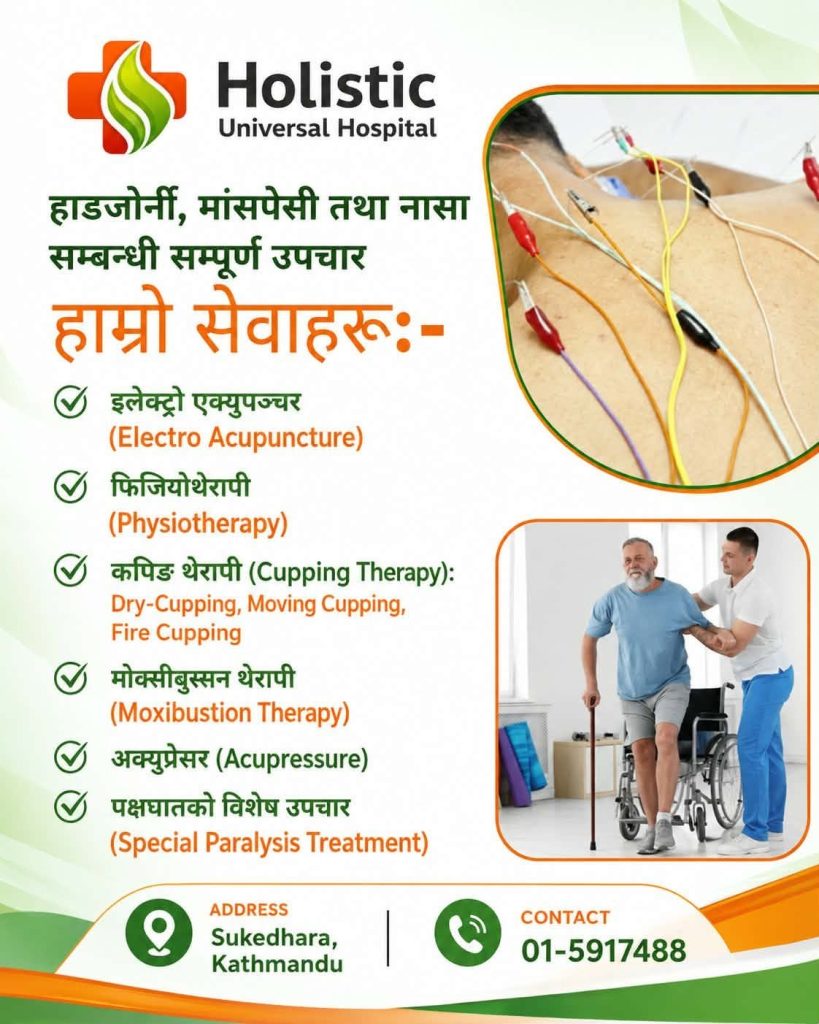
Holistic Universal Hospital, Sukedhara, Kathmandu, provides acupuncture as part of its broader range of complementary and integrative healthcare services.
The hospital’s approach is centered on looking at the individual rather than treating a symptom in isolation. Depending on the person’s needs, acupuncture may be incorporated alongside other services such as:
- Physiotherapy and rehabilitation
- Pain management
- Cupping therapy
- Moxibustion
- Moving cupping
- Hot stone therapy
- Diet therapy
- Steam therapy
- Shirodhara
- Sauna therapy
- Ultrasound therapy
The purpose is not to suggest that every person needs multiple therapies. Instead, treatment can be considered according to the individual’s condition, goals and professional assessment.
Why consider Acupuncture as part of integrative care?
Modern healthcare increasingly recognizes that managing many chronic conditions can require more than one approach.
For musculoskeletal problems, for example, appropriate physical activity, rehabilitation, lifestyle changes and conventional medical care may all have important roles.
Acupuncture can potentially complement these approaches for selected conditions, particularly where pain management is an important part of care.
It should not, however, be used as a reason to delay appropriate medical diagnosis or emergency treatment.
Is Acupuncture safe?
When performed by a properly trained and competent practitioner using sterile, single-use needles, acupuncture is generally considered safe.
However, acupuncture is not completely risk-free.
Improper technique or nonsterile equipment can cause infections or more serious injuries, including puncture of internal organs. This is why practitioner training, appropriate facilities, hygiene and sterile equipment are essential. WHO’s acupuncture benchmarks specifically address procedures, facilities and safety.
People who are pregnant, have bleeding disorders, take medicines that affect blood clotting, have implanted electrical devices or have other significant health conditions should inform their healthcare provider or acupuncture practitioner before treatment.
Acupuncture is not a miracle cure!!!
There is a lot of exaggerated information about alternative medicine online.
Acupuncture should not be marketed as a cure for every disease. Its strongest area of research is currently around certain pain conditions, while evidence for other conditions varies.
A responsible approach to Traditional Chinese Medicine means respecting its traditional principles while also understanding what modern research does and does not establish.
That balance is important for patients.
Who may consider Acupuncture?
Acupuncture may be worth discussing with a qualified practitioner if you are looking for complementary support for:
✓ Back or neck discomfort
✓ Certain joint-related pain
✓ Musculoskeletal problems
✓ Headaches or migraine
✓ Recovery and rehabilitation support
✓ A broader integrative approach to pain management
Your suitability should be assessed individually rather than assuming acupuncture is appropriate for everyone.
Why choose Holistic Universal Hospital?
At Holistic Universal Hospital, acupuncture is incorporated into a broader philosophy of integrative healthcare.
Rather than viewing traditional therapy and modern healthcare as competing systems, an integrative approach considers how different evidence-informed and traditional practices may complement appropriate medical care.
The goal is simple: understand the person, understand the problem and select an appropriate approach.
If you are considering acupuncture for a persistent health problem, a professional assessment is an important first step.
FAQs about Acupuncture
Does acupuncture really work?
Research suggests that acupuncture can help some people with certain pain conditions, including back and neck pain, knee osteoarthritis and headaches. The level of evidence varies by condition, and researchers are still investigating how acupuncture produces its effects.
How many acupuncture sessions are needed?
There is no universal number of sessions. Treatment frequency and duration depend on the individual’s condition, response to treatment and practitioner assessment.
Is acupuncture safe?
Acupuncture is generally considered safe when performed properly by a qualified practitioner using sterile needles. Improperly performed acupuncture can cause serious complications, which is why practitioner competence and hygiene are important.
Can acupuncture replace conventional medical treatment?
No. Acupuncture should not be used to delay necessary medical diagnosis or treatment. It may be used as a complementary approach for selected conditions.
Does acupuncture only treat pain?
Pain management is one of the most studied applications of acupuncture. Research is also examining acupuncture for other health concerns, but evidence varies considerably between conditions.
Experience Acupuncture Therapy at Holistic Universal Hospital
Acupuncture represents a remarkable meeting point between traditional Chinese medical knowledge and modern healthcare research.
For people dealing with selected pain and musculoskeletal conditions, it may offer another option to discuss with a qualified healthcare professional.
At Holistic Universal Hospital, Sukedhara, Kathmandu, acupuncture is available as part of an integrated range of natural and complementary healthcare services.
If you are considering acupuncture, start with an assessment rather than choosing a treatment based only on an online claim.
Your health is personal. Your treatment should be personal too.
Visit
Holistic Universal Hospital
Sukedhara, Kathmandu, Nepal
Phone: 01-5917488 / 9767987966
Website: holisticuniversal.com
Hours: 7:00 AM–7:00 PM, every day
You May like to Read more Blog
Cupping Therapy: What it is, benefits, safety and What to Expect?
Naturopathy Hospital in Nepal: Your Complete Guide
Hot Stone Therapy in Nepal: Holistic Universal Hospital
Leave a reply