
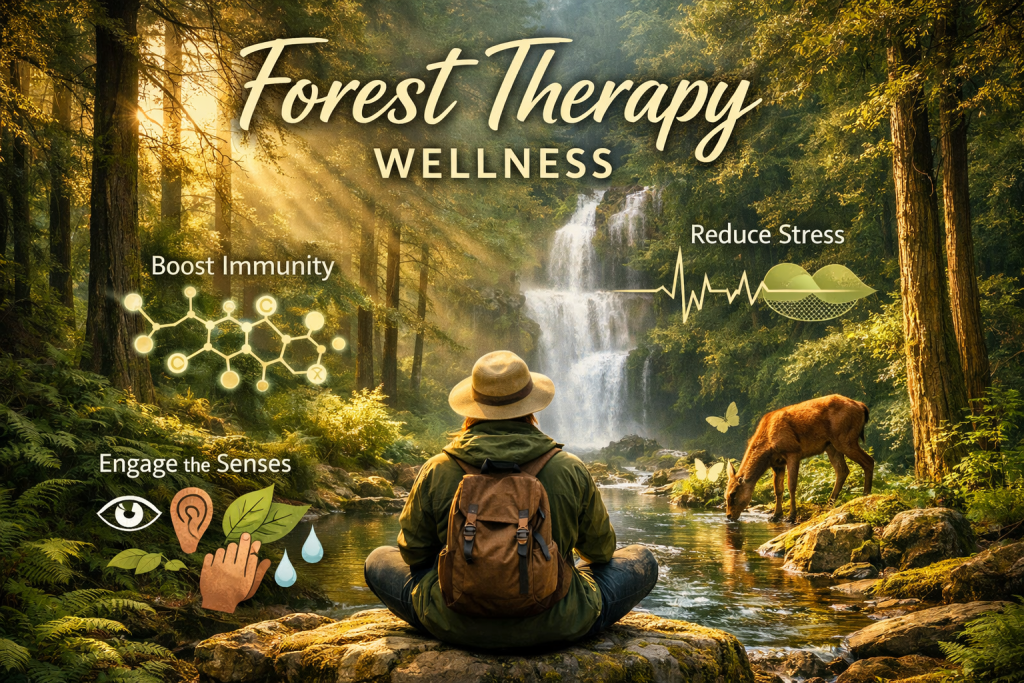
Forest Therapy: Returning to the Woods for Holistic Healing
We spend our days inside concrete boxes, staring at glass rectangles, breathing conditioned air and wondering why we feel chronically exhausted. Modern life has pulled us away from the very environment that shaped our biology for thousands of years. The result is a quiet epidemic of stress, anxiety and sensory overload.
Forest therapy, often referred to as forest bathing or Shinrin-yoku, offers a direct antidote to this digital fatigue. It is not just a walk in the woods or a fitness trend. It is a structured, intentional practice of engaging with nature to restore emotional, mental and physical balance. By looking at how this practice bridges traditional wisdom and modern medicine, we can understand why forest therapy is becoming a cornerstone of preventative healthcare.
An Ancient Practice with a Modern Name
While the term Shinrin-yoku was coined by the Japanese Ministry of Agriculture, Forestry and Fisheries in the 1980s, the underlying philosophy is as old as humanity. Long before urban living became the norm, traditional societies across the globe recognized the earth as a source of vitality and healing.
In Eastern philosophies, particularly Taoism and Vedic traditions, the human body is viewed as a microcosm of nature. When we separate ourselves from the elements, we disrupt our internal balance. Similarly, Indigenous cultures worldwide have practiced variations of nature-connected healing for millennia. For these communities, the forest was never a separate place to visit, it was an extension of the self. The trees, soil and rivers were treated as living entities capable of offering guidance and restoring health.
Modern forest therapy takes these ancient insights and translates them for a secular, fast-paced world. It strips away the abstract mysticism and focuses on the direct, experiential relationship between humans and the natural environment.

The Biological mechanics of the Woods
It is easy to dismiss nature therapy as a subjective, feel-good activity. However, a growing body of rigorous medical research proves that the benefits are physical and measurable. The forest alters your biochemistry.
When we walk through a dense forest, we breathe in airborne compounds called phytoncides. These are antimicrobial volatile organic compounds released by plants and trees to protect themselves from insects and disease. When humans inhale phytoncides, our bodies respond by increasing the number and activity of a type of white blood cell called natural killer (NK) cells. These cells are vital for immune health, as they target and destroy virus-infected cells and cancerous tumors. A single weekend in a heavily forested area can boost NK cell activity for up to thirty days.
Beyond immune support, forest therapy fundamentally resets the nervous system. The constant stimulation of city life, from traffic noise to incoming email alerts, keeps our bodies in a prolonged state of low-grade fight-or-flight response. This chronic elevation of cortisol and adrenaline damages blood vessels, impairs digestion and disrupts sleep.
Spending time in a forest activates the parasympathetic nervous system, which is responsible for rest and recovery. Studies show that forest therapy consistently drops cortisol levels, lowers heart rates and stabilizes blood pressure far more effectively than walking an equal distance on a city treadmill.
Restoring Sensory Balance
Most modern wellness routines focus on isolated actions: changing a diet, lifting weights, or taking a specific supplement. Forest therapy operates holistically by engaging all five senses simultaneously. This sensory immersion is what calms an overstimulated mind.
Visual Harmony: The visual landscape of a forest is dominated by natural geometric patterns known as fractals. These repeating shapes, found in tree branches, ferns and river networks, are easily processed by the human brain. Unlike the sharp angles and chaotic movement of urban environments, looking at fractals induces alpha brain waves, which are associated with a relaxed yet alert mental state.
Acoustic Sanctuary: The sounds of the forest, such as rustling leaves, flowing water and birdsong, are non-threatening acoustic patterns. They allow our auditory processing centers to rest. Research indicates that these natural sounds actively reduce cognitive fatigue and help restore our capacity for focused attention.
Tactile and Olfactory Grounding: The scent of damp soil, rotting wood and pine needles comes from geosmin and plant terpenes. These scents trigger deep, primitive areas of the brain associated with memory and emotion, instantly shifting our mood. Touching rough bark, walking on soft moss, or dipping your hands into a cold stream grounds your awareness in the present moment, cutting off the cycle of repetitive, stressful thoughts.
How to practice Forest Therapy without the fluff?
You do not need an expensive guide or a remote wilderness to experience forest therapy. You just need a shift in intent. The goal is connection, not exercise. If you are tracking your steps, checking your heart rate monitor, or rushing to reach a specific viewpoint, you are missing the point.
Here is a practical framework to integrate forest therapy into your life:

Disconnect radically: Put your phone on airplane mode and leave it in your pocket. Better yet, leave it in your car. If you are thinking about taking a photo for social media, you are still mentally trapped in the digital grid.
Slow down: Move through the space without a destination. Walk at a pace that allows you to notice the small details, like a beetle moving across a root or the way light filters through the canopy.
Engage your senses explicitly: Spend a few minutes focusing entirely on one sense at a time. What are the three quietest sounds you can hear? How many different shades of green can you see? What does the underside of a leaf feel like?
Sit still: Find a comfortable spot at the base of a tree or on a rock and sit quietly for fifteen minutes. Let the forest adjust to your presence. As your movement stops, wildlife will return to its natural patterns and you will become part of the landscape rather than an intruder.
A Forward-Thinking view on wellness
As urbanization increases and digital infrastructure becomes even more immersive, our psychological need for nature will only grow. Forest therapy is transitioning from a niche wellness trend into a recognized medical intervention. Doctors in several countries are now writing green prescriptions, directing patients to spend specific blocks of time in nature to manage clinical anxiety, depression and metabolic syndromes.
We must stop viewing time spent in nature as a luxury or a hobby to fit into the weekend. It is a biological necessity. Protecting our forests is not just an ecological duty, it is a matter of public health.
By returning to the woods, we are not escaping reality. We are returning to the environment where our minds and bodies function exactly as they were designed to.
📍 Visit us at: Holistic Universal Hospital: https://maps.app.goo.gl/BpToD4xy3k6NaE8K8
📞 Book your appointment today: 01-5917488/ 9767987966
🌐 Learn more: https://holisticuniversal.com/
📅 Open: 7 days a week
You May like to Read more Blog
Acupressure: Ancient Healing Touch for Modern Holistic Wellness
Holistic Treatment Mechanism: Integrative Healthcare with Holistic Universal Hospital
Comfortable Healing: The Gentle Path to Holistic Health and Wellness
Special Offer by Holistic Universal Hospital

Leave a reply